
A.05 Final Summation
- Dec 10, 2024
- 9 min read
Updated: Aug 30, 2025
Iteration #1
1) Lecture Topics
a) The Role of Emerging Technologies Such as Parametric/Robotic and Digital Fabrication/Prototyping in Architecture
b) The Role of Speculative Architecture - Theory
c) The Role of Experiential (Phenomenology/Spatial Sequencing) vs Formal (Parametric/Biomimicry) Architecture
2) Guest Lecturers
a) Santiago Perez, FAMU
b) Ms. Antoinette Oni, Nigerian/British
c) Doreen Bernath, Architectural Association London
3) AI Suggested Readings
4) AI Summaries
"Transforming Architecture: The Synergy of Digital Fabrication and Parametric Design"
This paper explores the transformative integration of digital fabrication and parametric design in architecture. It traces the evolution of digital fabrication from basic CNC machinery to advanced 3D printing and robotic assembly, highlighting the shift from mass production to mass customization. Parametric design is examined for its algorithmic capabilities, allowing manipulation of complex geometries based on set parameters, which facilitates designs that adapt to environmental data for enhanced sustainability. The synergy between these technologies is showcased through case studies, demonstrating their combined potential to innovate architectural practices.
"Speculative and Critical Design — Features, Methods, and Practices"
This article delves into Speculative and Critical Design (SCD), which challenges traditional design practices by provoking public debate on preferable societal developments. It outlines the main features, methods, and practices of SCD, including speculative narratives and the design of critical objects. The piece also addresses the theoretical foundations of SCD, aiming to situate it within the broader design field and discussing its role in questioning and reshaping contemporary perceptions of products and services.
"Biomimicry in Architecture: From Theory to Practice"
This chapter examines the application of biomimicry in architecture, focusing on integrating natural processes with technological tools to inspire innovative designs. It discusses how architects can emulate nature's time-tested patterns and strategies to create sustainable and efficient structures. The text provides insights into the theoretical underpinnings of biomimicry and offers practical examples of its implementation in architectural projects, highlighting the potential for a harmonious relationship between built environments and the natural world.
5) Connections
1. Technology as a Mediator for Design Innovation
Digital Fabrication and Parametric Design explores how technology enables architects to manipulate complex geometries and produce innovative designs through digital tools like CNC and 3D printing.
Speculative and Critical Design uses technology as a platform to provoke critical thought and develop alternative design futures, emphasizing the role of digital tools in creating speculative artifacts.
Biomimicry in Architecture leverages advanced computational methods to emulate natural forms and processes, showcasing technology's role in translating organic patterns into architectural solutions.
2. Critical Thinking and New Design Paradigms
Speculative and Critical Design challenges traditional design frameworks by introducing critical narratives and thought-provoking prototypes, encouraging reflection on societal and environmental futures.
Digital Fabrication and Parametric Design proposes a paradigm shift in construction and design processes, moving from traditional craftsmanship to algorithm-driven customization.
Biomimicry in Architecture reframes design thinking by studying nature's principles, encouraging architects to rethink how forms and systems can be more adaptive and efficient.
3. Sustainability and Resilience
Biomimicry in Architecture directly addresses sustainability by mimicking nature's efficient systems, offering solutions that align with ecological balance.
Digital Fabrication and Parametric Design facilitates resource efficiency by minimizing waste through precise fabrication and adaptable designs, contributing to sustainable practices.
Speculative and Critical Design indirectly addresses sustainability by fostering critical discourse around societal and environmental issues, guiding more informed and responsible design decisions.
6) What was learned?
In these article summaries, it was eye-opening to actually hear the definition of parametric design. As architectural designers, we are aware of parametric design and we know what it is. However, hearing it be described as a "manipulation of complex geometries based on set parameters" lit a spark in mind that reflected a sense of, "Yeah, it is, huh?"
The readings also deepened my understanding of the relationship between technologies, like digital fabrication and parametric design, and experiential human-centered approaches. Tools like laser cutters and 3D printers (which are now common to me) are part of a broad framework that combines formal innovation with tangible user benefits. Learning how speculative architecture can foster critical thinking and adaptive solutions has expanded my view on how these methods integrate with social and environmental goals.
7) Reflection
My experience with Revit, Enscape, laser cutters, and 3D printers has given me a strong foundation in bridging digital design with real-world fabrication. Using these tools has helped me appreciate how technology can transform abstract ideas into tangible, functional architectural elements. Speculative architecture, with its emphasis on exploring “what could be,” inspires me to think beyond conventional approaches and imagine designs that innovate and challenge norms.
The hands-on nature of laser cutting and 3D printing has also allowed me to refine my iterative design process, where I experiment with both form and function to achieve thoughtful outcomes. These tools align perfectly with parametric and biomimetic methods, helping me explore designs that adapt to human behavior and environmental conditions.
Looking ahead, I hope to integrate experiential and formal approaches in my projects, blending human-centered phenomenology with advanced digital tools. My background in AI prompt engineering adds another layer of potential, enabling me to push boundaries in speculative and adaptive design.

Source: chatgpt

Source: chatgpt
Iteration #2
1) Lecture Topics
a) The Role of Health & Well-Being - Biophilic/Bioclimatic Design, Environmental Justice - in Architecture
b) The Role of Climate Change in Informing Design Resilience in Architecture
c)The Role of "The Other" in Architecture - Historically Marginalized People, Feminism, LGBTQ, and Displaced People
2) Guest Lecturers
a) Alia Fadel, Senior Lecturer in Landscape Architecture, LEEDS Beckett University, UK
b) Ian Fletcher, FAMU
c) Zaid Awamleh, PHD Candidate LEEDS Beckett University, UK
3) AI Suggested Readings
4) AI Summaries
"Biophilic and Bioclimatic Architecture: Analytical Therapy for the Next Generation of Passive Sustainable Architecture"
This book explores the integration of biophilic and bioclimatic principles in architectural design, emphasizing the importance of connecting occupants with nature to enhance well-being. It discusses how passive sustainable strategies can be employed to create environmentally friendly and health-promoting buildings. The author provides analytical tools and methodologies for architects to design spaces that are both energy-efficient and conducive to human health.
"Design for Resilient Communities at the UIA World Congress of Architects 2023"
This article discusses the themes presented at the UIA World Congress of Architects 2023, focusing on designing resilient communities in the face of climate change. It highlights innovative architectural solutions that address environmental challenges and promote sustainability. The piece emphasizes the importance of community involvement and adaptive design strategies to enhance resilience against climate-related impacts.
"Framing Queer Resilience and Climate Justice"
This article examines the intersection of LGBTQ+ communities and climate justice, highlighting the unique vulnerabilities and resilience strategies of queer individuals in the face of climate change. It discusses the importance of inclusive climate action that considers the specific needs of marginalized groups, advocating for policies and designs that promote equity and justice.
5) Connections
Inclusive Resilient Design:
Integrating biophilic and bioclimatic principles can enhance the resilience of communities to climate change while promoting health and well-being. Designs that consider environmental justice ensure that marginalized groups benefit from these strategies, leading to more equitable and sustainable outcomes.
Community-Centered Approaches:
Addressing the impacts of climate change requires involving historically marginalized communities in the design process. By incorporating diverse perspectives, architects can create spaces that are not only resilient but also culturally sensitive and inclusive.
Holistic Sustainability:
A comprehensive approach to sustainability in architecture considers environmental, social, and economic factors. By addressing the needs of marginalized populations and promoting health and well-being through biophilic design, architects can contribute to a more just and resilient built environment.
6) What was learned?
Based on these readings, I have learned more about the intersection of environmental justice and health-focused architecture, specifically how biophilic strategies can serve as solutions for marginalized communities. The readings emphasized the unique vulnerabilities of underserved populations to climate change and how inclusive design can mitigate these effects. This shifted my perspective on the role of architects as advocates for systemic change, emphasizing the importance of involving affected communities in decision-making. This also gave birth to a new sense of awareness I feel that architects should have, because personally, I never before gave thought to how specific underserved populations are impacted by climate change.
7) Reflection
My academic studies and designs of community centers and other civic architectural projects have taught me the importance of designing for health, equity, and resilience. These projects emphasized creating spaces that address systemic inequalities while fostering well-being through green infrastructure and biophilic strategies. I also maintain a personal design philosophy and commitment to inclusive design practices that center marginalized communities.
In the future, I aim to expand this work by integrating climate-resilient solutions tailored to vulnerable populations. Incorporating strategies like sustainable materials, renewable energy systems, and community-led design processes will allow me to create spaces that are equitable and sustainable. I see opportunities to use architecture as a tool for social and environmental justice, bridging the gap between innovative design and the needs of underserved communities. By focusing on health and equity, I hope to contribute to environments that not only adapt to climate challenges but also empower and uplift those who inhabit them.

Source: chatgpt
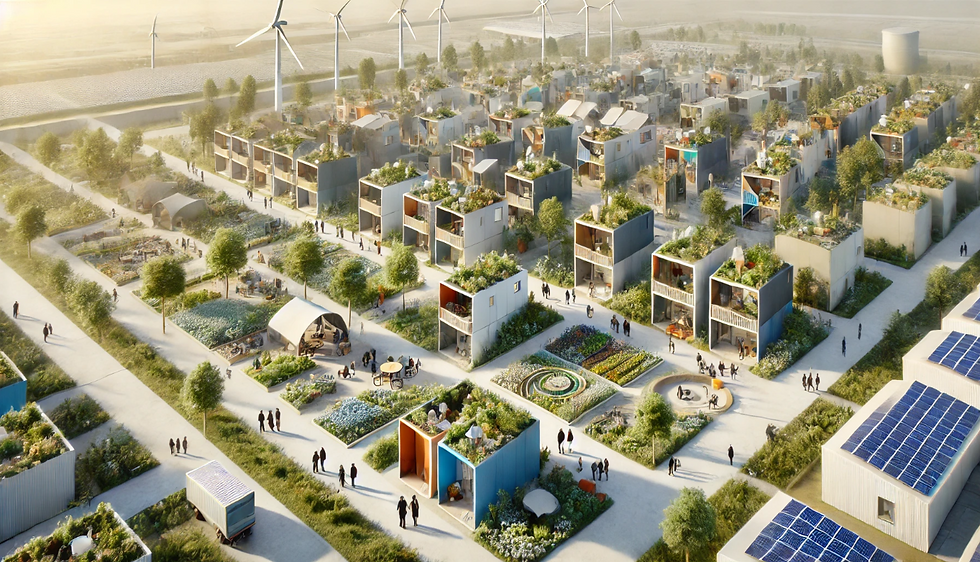
Source: chatgpt
Iteration #3
1) Lecture Topics
a) The Role of Social Responsibility - Agency/Community Engagement - in Architecture
b) The Role of Material/Tectonic Exploration in Architecture
c) The Role of Sustainability - Environmental, Material, Socio-Economic, Cultural Heritage - in Architecture
2) Guest Lecturers
a) Dr. Simon Warren, Former Director of Part 3 & Degree Apprenticeship, LEEDS Beckett University, UK
b) Santiago Perez, FAMU
c) Mariam Kamara, Nigerian Architect
3) AI Suggested Readings
4) AI Summary
"Architecture's Evolving Role: How Community-Engaged Design Can Encourage Social Change"
This article explores the shifting role of architects towards more community-engaged design practices. It emphasizes the importance of involving local communities in the design process to address social issues effectively. The piece highlights various projects where architects have collaborated with communities to create spaces that foster social change and inclusivity.
"Back to Basics: What is the Meaning of 'Tectonic' in Architecture Today?"
This article delves into the contemporary understanding of tectonics in architecture, focusing on the expressive potential of construction techniques and materials. It discusses how modern architects are reinterpreting traditional tectonic principles to create structures that are not only functional but also convey meaning and respond to socio-cultural contexts.
"Social Sustainability in Architecture: Designing for People and Place"
This article examines the concept of social sustainability in architecture, emphasizing the creation of spaces that promote well-being, inclusion, and community cohesion. It discusses strategies such as community engagement, accessibility, and the preservation of cultural heritage to design environments that are socially sustainable and responsive to the needs of diverse populations.
5) Connections
Community-Centric Design:
Both social responsibility and social sustainability emphasize the importance of engaging communities in the design process to create spaces that reflect their needs and values. This approach fosters a sense of ownership and ensures that the built environment supports social cohesion.
Material Expression and Cultural Identity:
Tectonic exploration in architecture allows for the expression of cultural identity through materials and construction methods. By thoughtfully selecting and assembling materials, architects can honor cultural heritage and contribute to the socio-economic sustainability of communities.
Holistic Sustainability:
Integrating environmental considerations with socio-economic and cultural factors leads to holistic sustainability in architecture. Designs that are environmentally responsible, culturally sensitive, and socially inclusive contribute to the long-term resilience and vitality of communities.
6) What was learned?
These readings introduced me to the deeper cultural and philosophical implications of tectonic design. While I already choose materials for their functionality (as well as aesthetics), I have gained a new perspective on how they communicate cultural identity and sustainability. Understanding the relationship between material exploration and socio-economic impact further emphasizes the importance of sourcing local, sustainable materials. I see how these elements align with a holistic approach to sustainability.
7) Reflection
As stated above, past projects of mine have shown me the power of community engagement and how architecture can serve as a catalyst for positive change. These projects and the studies of related precedents have taught me the value of involving local communities and using materials thoughtfully to honor cultural heritage. Additionally, my academic studies of tectonic design deepened my understanding of the potential of materials and construction techniques, inspiring me to see architecture as both technical and poetic.
Looking forward, I want (more often) to design spaces that prioritize cultural heritage while embracing environmental and socio-economic sustainability. Integrating local materials and honoring traditional techniques can support sustainability while fostering a sense of identity and pride within communities. My goal is to create spaces that reflect their cultural and environmental contexts, ensuring they are impactful, resilient, and deeply connected to the people they serve. Through thoughtful design, I hope to demonstrate how architecture can harmonize technical innovation with social responsibility.

Source: chatgpt

Source: chatgpt
Source of all information: ChatGPT


Comments