
A.06 Contemporary Research Informed Practices: Husos Architects & Colloqate Design Comprehensive Comparison
- Nov 13, 2025
- 2 min read
Studio Name: Husos Architects
Practice: Architecture and urban research studio focusing on ecological design, queer domesticities, and socio-environmental justice
Location: Madrid, Spain & Bogotá, Colombia
Lecture Name: Husos: Urbanisms for Homeless Species
Firm Name: Colloqate Design
Practice: Nonprofit design justice practice focused on racial equity, community power, and dismantling spatial injustice
Location: New Orleans, Louisiana
Lecture Name: Colloqate Design: Design Justice
About Husos Architects
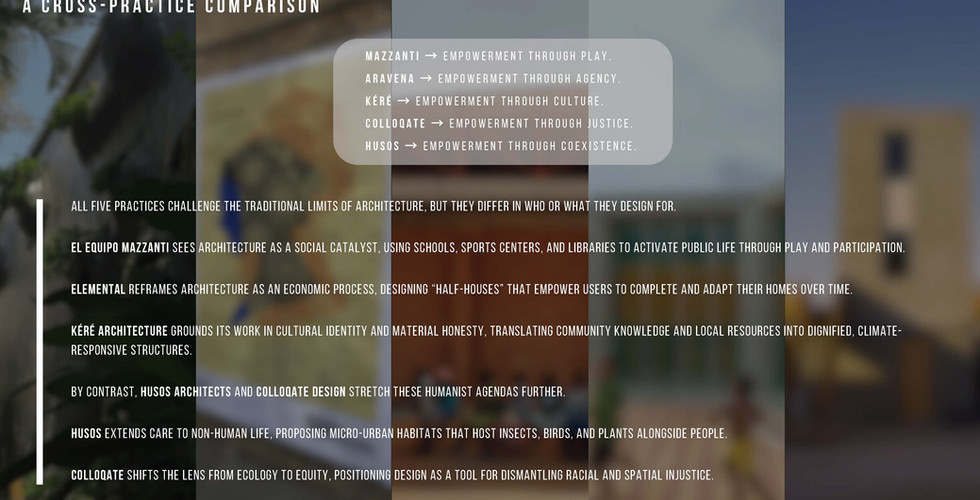
Husos is a research-driven architecture studio known for blending spatial design with ecological thinking and social activism. Their work often explores the relationships between humans, non-human species, climate, and contemporary urban life. In Urbanisms for Homeless Species, Husos unpacked how our built environments fail the ecological systems we depend on (especially insects, pollinators, and “non-human neighbors”) and how architecture can become a tool for repairing those relationships.
Their projects use small-scale interventions, material experiments, and narrative research to rethink ideas of home, habitat, and care. Whether designing micro-climates for butterflies, alternative domestic spaces for queer communities, or cooling structures for insects, Husos challenges architects to expand their definition of who (and what) the city is for.
Research Strategies
Research was focused on the Urbanisms for Homeless Species lecture and paired it with Husos’ published work and project documentation. I spent time analyzing how their ecological and social ideas show up in their designs, especially their insect hotels, micro-habitat prototypes, and climate-responsive garden systems. I also reviewed their writing on queer domesticity and multi-species urbanism to better understand the broader frameworks guiding their practice. Altogether, this helped me see how Husos uses architecture as a way to rethink care, environment, and daily life.

About Colloqate Design
Colloqate Design is a design justice practice dedicated to building spaces that confront and dismantle the racial, economic, and political inequities embedded in the built environment. Their work spans architecture, planning, community facilitation, and policy advocacy, all rooted in the belief that design must redistribute power rather than reinforce historic harm.
Central to their philosophy is Design Justice, a framework that centers the voices of communities who have been excluded from decision-making. Their projects often take the form of community workshops, public installations, and neighborhood-level planning that challenges policing, displacement, and discriminatory zoning. Colloqate approaches architecture as a tool for liberation, using design to support community autonomy, cultural preservation, and long-term self-determination.
Research Strategies
For this profile, I drew from Colloqate’s public talks, their Design Justice framework, and several case studies from their work in New Orleans and other communities. I focused on understanding how their process actually functions, how they facilitate conversations, document community histories, and challenge systems of spatial injustice through design. Looking at their writing and interviews helped me see how their activism connects directly to their architectural work, and how they use design as a tool for building power rather than just producing buildings.







Comments